

Operation Process and Working Principle of Lithium Iron Carbonate Powder Pneumatic Conveying Line
In the industrial powder handling field, efficient and stable conveying systems are crucial for the transport of key raw materials like Lithium Iron Carbonate. This article details the operation process and working principle of a Lithium Iron Carbonate powder pneumatic conveying line designed by Shandong HeadPowder Engineering Co., Ltd. (referred to as Headpowder), helping users fully understand the technical features and application value of the system.
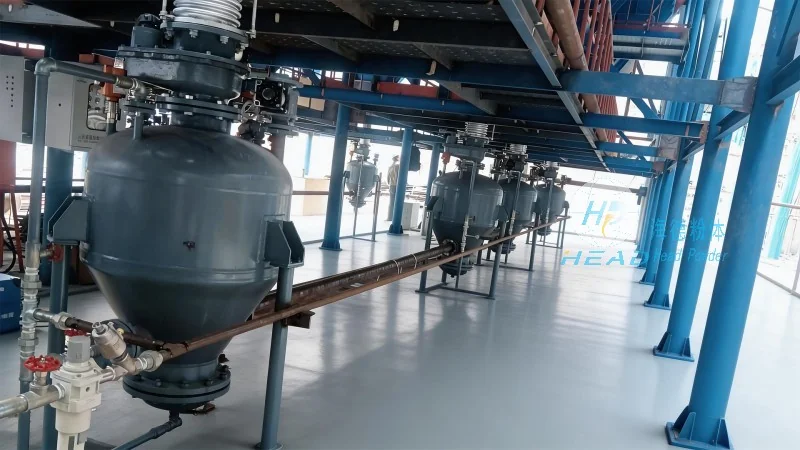
Lithium Iron Carbonate Powder Pneumatic Conveying Line Overview
Lithium Iron Carbonate (Lithium Iron Carbonate) is an important positive electrode material for lithium-ion batteries, and its production and transportation require high standards for equipment. Pneumatic conveying technology, with its advantages of no mechanical contact, good sealing, and long conveying distance, is an ideal choice for Lithium Iron Carbonate powder transport. Headpowder, based on years of engineering experience, designs and manufactures dedicated pneumatic conveying systems tailored to the physical properties of Lithium Iron Carbonate (such as particle fineness, density, and flowability), ensuring stable material transport and preventing agglomeration or leakage.
System Composition and Main Components
A Lithium Iron Carbonate powder pneumatic conveying line typically consists of multiple key components, each carefully designed to meet the transport needs of Lithium Iron Carbonate. The main components include feeding devices, conveying pipelines, air source systems, separation devices, and receiving equipment. The following explains each component in detail:
1. Feeding Device: Responsible for uniformly and continuously feeding Lithium Iron Carbonate powder from a hopper or storage tank into the conveying pipeline. Usually equipped with a star feeder or screw conveyor, the speed is adjusted to control the material flow rate and ensure stable transport. For Lithium Iron Carbonate, which is prone to static electricity, the feeding device is also equipped with an electrostatic elimination device to prevent static accumulation and safety hazards.
2. Conveying Pipeline: Made of corrosion-resistant and wear-resistant materials (such as stainless steel or special plastics), with a smooth internal surface to reduce friction between the material and the pipeline. The pipeline layout is designed according to the actual production environment, possibly including horizontal, vertical, or inclined sections. Properly placed elbows and reducers optimize airflow velocity and material transport efficiency. For long-distance transport, the pipeline may use branching structures to meet the material distribution needs of different areas.
3. Air Source System: Provides compressed air or inert gas (such as nitrogen) for conveying, typically consisting of an air compressor, storage tank, dryer, and filter. The air source system ensures the gas is dry and clean to avoid moisture or impurities entering the conveying pipeline, affecting the purity and performance of Lithium Iron Carbonate. The compressor's power and pressure are determined by the conveying volume and distance, usually using variable frequency control to adjust airflow velocity and adapt to different operating conditions.
4. Separation Device: At the conveying end, the separation device separates Lithium Iron Carbonate powder from the air stream and sends it to the receiving equipment. Common separation devices include cyclone separators, bag filters, or electrostatic precipitators. For fine-particle materials like Lithium Iron Carbonate, cyclone separators are widely used due to their high efficiency and low energy consumption. The separated powder is further processed by a vibrating screen or magnetic separator to ensure product purity.
5. Receiving Equipment: Receives the separated Lithium Iron Carbonate powder, typically a hopper or tank. The receiving equipment must have good sealing performance to prevent material leakage or external air entry, affecting material quality. Some systems are equipped with automatic weighing or flowmeters to monitor the conveying volume in real time and achieve precise production control.
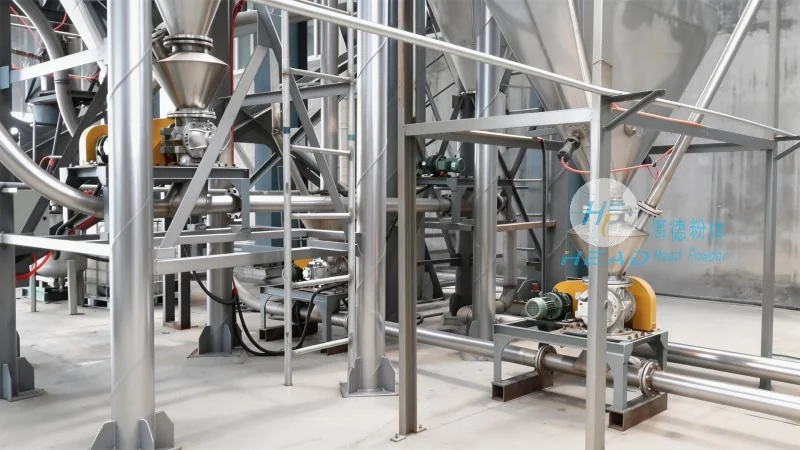
Operation Process Details
The operation process of a Lithium Iron Carbonate powder pneumatic conveying line is a continuous, automated cycle, including four stages: material feeding, conveying, separation, and receiving. The specific steps are as follows:
First Stage: Material Feeding. The feeding device sends Lithium Iron Carbonate powder from the raw material hopper into the conveying pipeline. At the same time, the air source system starts, injecting compressed air into the pipeline to form an air stream. The material is accelerated and enters the pipeline under the action of the air stream.
Second Stage: Material Conveying. The material moves in the pipeline at a certain speed under the action of the air stream. Due to the fine particles of Lithium Iron Carbonate, the airflow velocity is controlled within an appropriate range (usually 15-30m/s) to ensure stable suspension and avoid particle scattering or deposition. The pressure and flow rate in the pipeline are monitored in real time by sensors, and the system automatically adjusts the air source pressure or feeding amount based on feedback to maintain stable conveying.
Third Stage: Material Separation. When the material reaches the end point, it enters the separation device. The cyclone separator separates the powder from the air stream by centrifugal force, with the powder deposited at the bottom of the separator and entering the receiving equipment through the outlet. The air is discharged from the top of the separator and may be further purified by a bag filter before being discharged or recycled.
Fourth Stage: Material Receiving. The separated Lithium Iron Carbonate powder is sent to the receiving hopper, waiting for subsequent processing or packaging. At the same time, the system records parameters such as conveying volume, pressure, and temperature for production management. The entire operation process is automatically controlled by a PLC system, achieving unmanned operation and improving production efficiency and safety.
Working Principle Analysis
The working principle of a Lithium Iron Carbonate powder pneumatic conveying line is based on fluid mechanics and powder transport theory. Its core is to suspend and transport powder particles using the kinetic energy of the air stream, involving the following key principles:
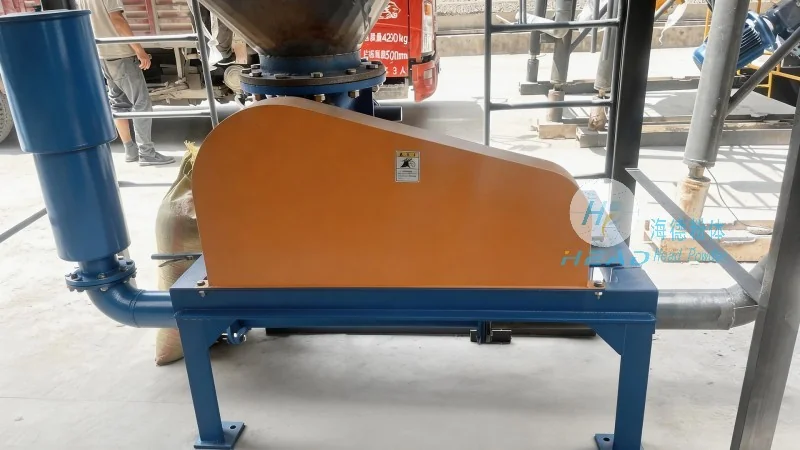
1. Suspension Conveying Principle: When the airflow velocity reaches a certain value, the powder particles are lifted and suspended in the pipeline. At this point, the relative velocity between particles and the air stream is small, reducing friction and conveying resistance. For fine-particle Lithium Iron Carbonate (density about 3.5g/cm³), the airflow velocity is adjusted to ensure stable suspension in the pipeline, avoiding deposition or blockage.
2. Bernoulli Effect: The increase in airflow velocity in the pipeline leads to a pressure drop, forming a negative pressure area. This pressure difference drives the material from the feeding device into the pipeline and moves it forward with the air stream. By reasonably designing the pipeline cross-section and airflow velocity, the pressure distribution is optimized to improve conveying efficiency.
3. Electrostatic Control Principle: Lithium Iron Carbonate particles may generate static electricity during transport, causing particles to adhere to the pipeline interior or equipment. Therefore, the system installs electrostatic elimination devices (such as grounded electrodes or ion guns) in the feeding device and pipeline interior to conduct or neutralize the charge, ensuring smooth transport.
4. Thermodynamic Equilibrium: The temperature and humidity of the gas provided by the air source system must match the storage conditions of Lithium Iron Carbonate to avoid material agglomeration or performance changes due to high temperature. Typically, the air source system is equipped with a dryer to control the gas humidity (e.g., dew point below -20℃) to prevent moisture from entering the conveying system and affecting the purity and battery performance of Lithium Iron Carbonate.
Headpowder's Technical Advantages
As a professional provider of powder engineering solutions, Shandong HeadPowder Engineering Co., Ltd. has significant advantages in the design and manufacturing of Lithium Iron Carbonate powder pneumatic conveying lines, based on its deep technical accumulation and rich project experience. The company focuses on customized development of powder conveying systems and provides full-process services from process design, equipment selection to installation and commissioning according to customers' actual production needs. The following are some technical advantages of Headpowder:
1. Customized Design: Tailored to the physical properties of Lithium Iron Carbonate (such as particle fineness, density, flowability), Headpowder uses advanced CFD (Computational Fluid Dynamics) simulation technology to optimize the design of the conveying system, ensuring the system operates under optimal conditions. For example, by simulating pressure distribution under different airflow velocities and pipeline layouts, the optimal conveying parameters are selected to improve efficiency and reduce energy consumption.
2. Corrosion-Resistant and Wear-Resistant Material Application: The conveying process of Lithium Iron Carbonate may cause corrosion or wear to equipment. Headpowder uses corrosion-resistant and wear-resistant materials (such as stainless steel, ceramics, or special plastics) to manufacture key components (like conveying pipelines and separator interiors), extending equipment service life and reducing maintenance costs.